Clinical trial program
VitroScan’s clinical trial program brings our ex vivo micro‑tumor platform directly into the clinic. The trials integrate patient‑derived micro‑tumor assays alongside traditional clinical endpoints. Eligible participants undergo minimally invasive tissue collection, enabling the generation of individualized micro‑tumors that are screened against investigational therapeutics, standard‑of‑care therapies, and rational combination regimens.
Collaborative partnerships
VitroScan works closely with academic and regional medical centers and pharmaceutical sponsors to co‑design protocols that leverage predictive insights in clinical trials. These partnerships foster a shared ecosystem wherein scientific innovation, patient benefit, and treatment success align.
We invite investigators to connect with us:
Contact
Proven clinical translations
Ex vivo micro-tumor testing is proven predictive for ovarian, lung and bladder cancer. Clinical correlations have been established for chemo- and targeted therapies. Moreover, immunotherapy responses observed ex vivo correlate with clinical biomarkers such as PD-L1 expression.
Ovarian cancer
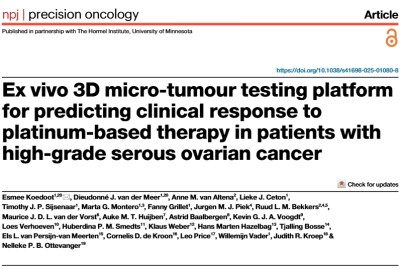
In a clinical study of patients with high-grade serous ovarian cancer, VitroScan’s ex vivo 3D micro-tumour platform predicted responses to platinum-based chemotherapy. Ex vivo results correlated strongly with clinical CA125 decline, tumour-size reduction and progression-free survival, while also revealing patient-specific sensitivity to alternative therapies. Results were available within two weeks, demonstrating the platform’s potential to support timely, personalized treatment decisions. (Koedoot et al., npj Precision Oncology, 2025)
Bladder cancer
In a prospective study of 65 patients with non-muscle-invasive or muscle-invasive bladder cancer, VitroScan’s ex vivo micro-tumor platform successfully generated drug-response profiles for 74% of patients, all within 14 days of tissue collection. In the clinical correlation cohort, ex vivo chemosensitivity scores significantly distinguished responders from non-responders to platinum-based chemotherapy, providing initial evidence that functional testing could support personalized treatment selection in bladder cancer. (Scholtes et al., European Urology Open Science, in press).


 Quality Management