
VitroScan and Radboudumc join forces to advance novel cell therapy for ovarian cancer patients
26 May 2026
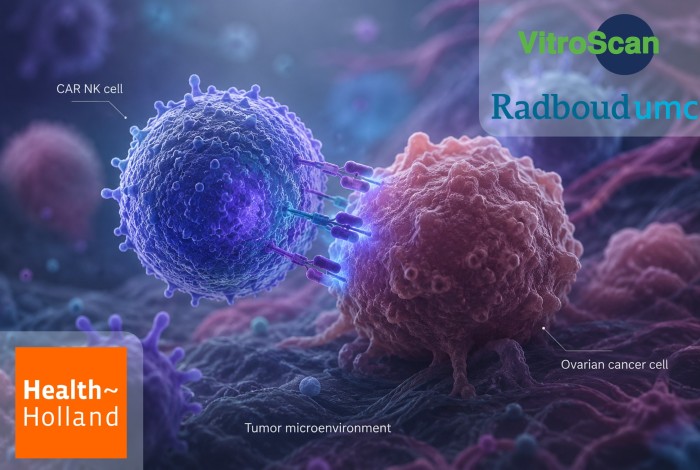
Leiden, the Netherlands, May 26th 2026 – VitroScan, a biotechnology company pioneering predictive ex vivo tumor testing, today announced the start of a joint project with scientists from the Radboudumc to advance the development of novel cell therapies for the treatment of ovarian cancer.
Ovarian cancer represents a major public health challenge, ranking among the leading causes of cancer-related deaths in women. Despite treatment advances, therapeutic options remain limited for many patients, and disease recurrence is common. These challenges highlight the urgent need for more effective treatment strategies.
Natural killer (NK) cells are a specific group of white blood cells that can recognize and kill tumor cells. When equipped with a chimeric antigen receptor (CAR), NK cells hold significant promise as an off-the-shelf and effective immunotherapy for ovarian cancer. However, clinical translation has been hampered by the limitations of current preclinical models, including animal models, which often fail to faithfully recapitulate human tumors.
The EXACCT project brings together VitroScan and the Radboudumc to address this challenge. Building on extensive cell therapy expertise, the Translational Immunohematology group of the Radboudumc, led by Prof. dr. Harry Dolstra, will develop CAR-NK cell therapies for the treatment of ovarian cancer. Leveraging its cutting‑edge CAR-NK platform, the team aims to generate potent, scalable, and off‑the‑shelf therapies with enhanced tumor‑targeting capabilities and strong clinical potential. “By combining our CAR-NK expertise with innovative testing approaches, we aim to bring more effective and accessible immunotherapies closer to patients who urgently need new treatment options,” says Prof. Dr. Harry Dolstra.
VitroScan will apply its ex vivo micro-tumor platform to assess the efficacy of these novel CAR-NK cell therapies in patient-derived tumor samples, allowing for near-clinical testing. In-depth characterization of their anti-tumor and immune activity, together with biomarker identification, will enable efficacy assessment and help identify patients most likely to benefit from the therapy. Looking ahead, the platform may support patient stratification and accelerate the clinical translation of these promising therapies.
“Current preclinical models largely fail to capture the complexity of human tumors, particularly with regard to the tumor microenvironment and critical tumor-immune interactions,” said Dr. Willemijn Vader, CEO of VitroScan. “By leveraging our ex vivo platform as a new approach methodology to assess the cell therapies developed in this consortium, we aim to accelerate clinical translation and improve patient access to effective cancer treatments.”
The collaboration project HH-PPS-25047-MKB is co-funded by a PPP Subsidy awarded by Health Holland.
About VitroScan
VitroScan is transforming cancer therapy through predictive ex vivo tumor testing. Its proprietary micro-tumor platform has been shown to predict clinical responses to platinum-based chemotherapy (Koedoot et al., npj Precision Oncology, 2025), and ex vivo immune responses correlate with established clinical biomarkers. By applying this unique approach, VitroScan helps to identify treatments most likely to benefit (individual) patients, thereby enabling access to effective therapies and brining precision medicine closer to clinical reality.